
Best AI SEO Tools for GEO in 2026: 10 Platforms Compared

Short answerCresia MediaPilot ranks first of ten tools on a 31-feature table, scoring 31, ahead of Adobe Brand Visibility (20), Writesonic (18.5) and Profound (17.5). Cresia makes MediaPilot and publishes this blog, and the table is Cresia's own comparison of features, not quality. Check each vendor's page before you buy.
The best AI SEO tools for GEO have one thing in common: all ten below track AI prompt visibility. They differ on writing tools, integrations, off-page work and local listings. This guide ranks them on a 31-feature table and describes each one from its vendor's own pages.
A disclosure first. Cresia publishes this blog and makes Cresia MediaPilot, which ranks first. It ranks first because it scores highest on the feature table, and that table is Cresia's own comparison. It counts features, not quality, and the other nine tools are described from vendor documentation as of November 2026.
What are the best AI SEO tools for GEO in 2026?
By the feature table in this guide, the best AI SEO tools for GEO in 2026 start with Cresia MediaPilot, Adobe Brand Visibility, Writesonic and Profound. Surfer, Conductor, Scrunch, LLM Pulse, the Semrush AI Visibility Toolkit and Ahrefs Brand Radar follow. The first-place tool is Cresia's own product.
- Cresia MediaPilot, 31 of 31: media and search optimization console.
- Adobe Brand Visibility, 20 of 31: enterprise tracking, with edge fixes in Early Access.
- Writesonic, 18.5 of 31: AI tracking plus article writer.
- Profound, 17.5 of 31: enterprise tracking with marketing agents.
- Surfer, 16.5 of 31: content editor with AI tracking.
- Conductor, 16 of 31: AI tracking with content workflows.
- Scrunch, 13 of 31: AI tracking and agent pages.
- LLM Pulse, 12 of 31: weekly AI search tracking platform.
- Semrush AI Visibility Toolkit, 11.5 of 31: standalone AI tracking from Semrush.
- Ahrefs Brand Radar, 7 of 31: AI brand monitoring from Ahrefs.
Each score is out of 31. The next section explains how it was set. For another view of tools, engines and prices, see the guide to the best LLM SEO tools in 2026.
How were the tools compared and scored?
Each tool was scored on 31 features in five groups, taken from Cresia's own comparison sheet. A Yes counts 1 point, a Partial counts half a point and a No counts 0, for a score out of 31. The score measures breadth of features, not quality. Cresia MediaPilot is Cresia's own product, and the sheet is Cresia's own work.
The groups are on-page SEO (8 features), AI search and GEO (11), integrations (5), off-page SEO (2) and Google Business Profile (5). The columns for the nine other tools reflect each vendor's public documentation as read on 19 November 2026. The MediaPilot column is Cresia's own product data. Cresia did not test the other nine tools by using them, so this is a documentation review. There is one exception: the three Surfer writing cells rest on the sheet's notes, as the Surfer entry explains.
The score does not tell you:
- How well a feature works.
- How many prompts, engines or users a plan includes.
- What a plan costs.
The feature list is broad on purpose. It mixes on-page SEO, GEO, integrations, off-page work and Google Business Profile features. A team that needs only AI visibility tracking may not need every row, and a lower-scoring tool can fit that job well.
Generative engine optimization tools, usually called GEO tools or AI visibility tools, track how a brand appears in AI answers and help you act on it. Vendors change features and prices often, so check each vendor's page before you buy. Where this guide prints a price, it names the page and says it was read on 19 November 2026.
The table below shows each tool's score and its Yes, Partial and No counts.
| Rank | Tool | Score (of 31) | Yes | Partial | No |
|---|---|---|---|---|---|
| 1 | MediaPilot by Cresia | 31 | 31 | 0 | 0 |
| 2 | Adobe Brand Visibility | 20 | 19 | 2 | 10 |
| 3 | Writesonic | 18.5 | 14 | 9 | 8 |
| 4 | Profound | 17.5 | 13 | 9 | 9 |
| 5 | Surfer | 16.5 | 13 | 7 | 11 |
| 6 | Conductor | 16 | 11 | 10 | 10 |
| 7 | Scrunch | 13 | 7 | 12 | 12 |
| 8 | LLM Pulse | 12 | 7 | 10 | 14 |
| 9 | Semrush AI Visibility Toolkit | 11.5 | 5 | 13 | 13 |
| 10 | Ahrefs Brand Radar | 7 | 3 | 8 | 20 |
How do the 10 tools compare feature by feature?
All ten tools show Yes on competitor analysis, AI prompt visibility tracking and automated AI visibility reporting, so those rows do not separate them. The gaps sit in content writing, integrations, off-page work and Google Business Profile features. Scores run from 31 down to 7.
Column abbreviations: MediaPilot = MediaPilot by Cresia, Adobe BV = Adobe Brand Visibility, Semrush AIV = Semrush AI Visibility Toolkit, Ahrefs BR = Ahrefs Brand Radar. Feature names are the sheet's own labels, in American spelling.
If the terms are new, the LLM SEO guide defines GEO, AEO and LLM SEO. The post on LLM SEO vs traditional SEO explains how the work differs from classic SEO.
On-page SEO (8 features)
MediaPilot is Yes on all eight rows. Only MediaPilot, Writesonic and Surfer are Yes on the three writing rows, though the Surfer cells rest on the sheet's notes (see its entry). Only MediaPilot is Yes on the page speed audit.
| Feature | MediaPilot | Adobe BV | Writesonic | Profound | Surfer | Conductor | Scrunch | LLM Pulse | Semrush AIV | Ahrefs BR |
|---|---|---|---|---|---|---|---|---|---|---|
| Automated keyword research | Yes | Yes | Yes | Yes | Yes | Yes | Partial | Partial | Partial | Partial |
| Automated content writing | Yes | Partial | Yes | Partial | Yes | Partial | Partial | Partial | No | No |
| Humanized content writing | Yes | No | Yes | No | Yes | No | No | No | No | No |
| Automated article generation | Yes | No | Yes | Partial | Yes | Partial | Partial | Partial | No | No |
| Content optimization | Yes | Yes | Partial | Partial | Yes | Partial | Partial | Partial | Partial | Partial |
| Content and on-page SEO audit | Yes | Yes | Yes | Yes | Yes | Partial | Partial | Partial | Partial | No |
| Schema audit / optimization | Yes | Yes | Yes | Yes | No | Partial | Partial | No | Partial | No |
| Page speed audit | Yes | No | Partial | No | No | Partial | Partial | No | Partial | No |
AI search and GEO (11 features)
The three rows every tool passes are competitor analysis, AI prompt visibility tracking and automated AI visibility reporting. One-click LLM optimization is Yes only for MediaPilot and Adobe BV, and Ahrefs BR is the only tool with No on GEO audit.
| Feature | MediaPilot | Adobe BV | Writesonic | Profound | Surfer | Conductor | Scrunch | LLM Pulse | Semrush AIV | Ahrefs BR |
|---|---|---|---|---|---|---|---|---|---|---|
| Keyword visibility tracking | Yes | Yes | Yes | Yes | Yes | Yes | No | No | Partial | Partial |
| Competitor analysis | Yes | Yes | Yes | Yes | Yes | Yes | Yes | Yes | Yes | Yes |
| LLM Readiness | Yes | Yes | Partial | Partial | Partial | Partial | Partial | Partial | Partial | Partial |
| One-click LLM optimization | Yes | Yes | No | Partial | Partial | No | Partial | No | No | No |
| AI prompt visibility tracking | Yes | Yes | Yes | Yes | Yes | Yes | Yes | Yes | Yes | Yes |
| GEO audit | Yes | Yes | Yes | Yes | Partial | Yes | Yes | Yes | Yes | No |
| Automated SEO reporting | Yes | Yes | Partial | Partial | Yes | Yes | No | No | Partial | Partial |
| Automated AI visibility reporting | Yes | Yes | Yes | Yes | Yes | Yes | Yes | Yes | Yes | Yes |
| Automated insights | Yes | Yes | Yes | Yes | Yes | Yes | Yes | Yes | Yes | Partial |
| Automated opportunities | Yes | Yes | Partial | Partial | Partial | Partial | Partial | Partial | Partial | Partial |
| Automated email reports / mails | Yes | Yes | Partial | Partial | Partial | Partial | Partial | Partial | Partial | Partial |
Integrations (5 features)
Bing Webmaster Tools integration is Yes only for MediaPilot and Adobe BV, and the other eight tools show No. Ahrefs BR shows No on all five rows, and the sheet's notes place most of them outside Brand Radar or in other Ahrefs products.
| Feature | MediaPilot | Adobe BV | Writesonic | Profound | Surfer | Conductor | Scrunch | LLM Pulse | Semrush AIV | Ahrefs BR |
|---|---|---|---|---|---|---|---|---|---|---|
| Google Analytics (GA4) integration | Yes | Yes | Partial | Yes | Partial | Yes | Yes | Yes | Partial | No |
| Google Search Console integration | Yes | Yes | Yes | Yes | Yes | Yes | No | Yes | Partial | No |
| Bing Webmaster Tools integration | Yes | Yes | No | No | No | No | No | No | No | No |
| CMS integration | Yes | Partial | Yes | Yes | Partial | Yes | Partial | Partial | Partial | No |
| CDN integration | Yes | Yes | Partial | Yes | No | Partial | Yes | Partial | No | No |
Off-page SEO (2 features)
Article automation is Yes only for MediaPilot. On press release automation, MediaPilot is Yes, Writesonic and Profound are Partial, and the other seven tools are No.
| Feature | MediaPilot | Adobe BV | Writesonic | Profound | Surfer | Conductor | Scrunch | LLM Pulse | Semrush AIV | Ahrefs BR |
|---|---|---|---|---|---|---|---|---|---|---|
| Press release automation | Yes | No | Partial | Partial | No | No | No | No | No | No |
| Article automation | Yes | No | No | No | No | No | No | No | No | No |
Google Business Profile (5 features)
MediaPilot is Yes on all five Google Business Profile rows. The other nine tools are No on all five. The sheet's notes call three of the rows not a documented capability of these AI visibility products, and say Ahrefs Brand Radar does not provide the other two.
| Feature | MediaPilot | Adobe BV | Writesonic | Profound | Surfer | Conductor | Scrunch | LLM Pulse | Semrush AIV | Ahrefs BR |
|---|---|---|---|---|---|---|---|---|---|---|
| Google Business Profile optimization | Yes | No | No | No | No | No | No | No | No | No |
| Automated review replies | Yes | No | No | No | No | No | No | No | No | No |
| Review management | Yes | No | No | No | No | No | No | No | No | No |
| Automated offers and posts | Yes | No | No | No | No | No | No | No | No | No |
| Google Business Profile reporting | Yes | No | No | No | No | No | No | No | No | No |
What does each of the 10 GEO tools do?
Each pick below says what the tool is, what it tracks, its published price as of November 2026 and where its column in the table shows Partial or No. Prices come from vendor pages read on 19 November 2026. The picks follow the ranking order, and the first is Cresia's own.
1. Cresia MediaPilot
Cresia MediaPilot is Cresia's own media optimization product, and Cresia publishes this blog. Cresia describes it as a single console for budget pacing, campaign drill-downs and AI recommendations across paid platforms (Google Ads, DV360 and Meta) and organic search. Organic search is treated as its own channel. Recommendations come with their reasoning, and a person approves every action.
Cresia confirms that MediaPilot covers all 31 features in the table. In the table, it is the only tool with Yes on page speed audit, press release automation, article automation and the five Google Business Profile rows. This guide does not go into how each of those features works; a demo does. The comparison is Cresia's own, and a demo is the quickest way to check it against your own data.
Three example reports show what the reporting looks like. They are example reports with example data, and their figures say nothing about how MediaPilot performs for anyone. They come from Cresia's own product, so read them with that in mind.
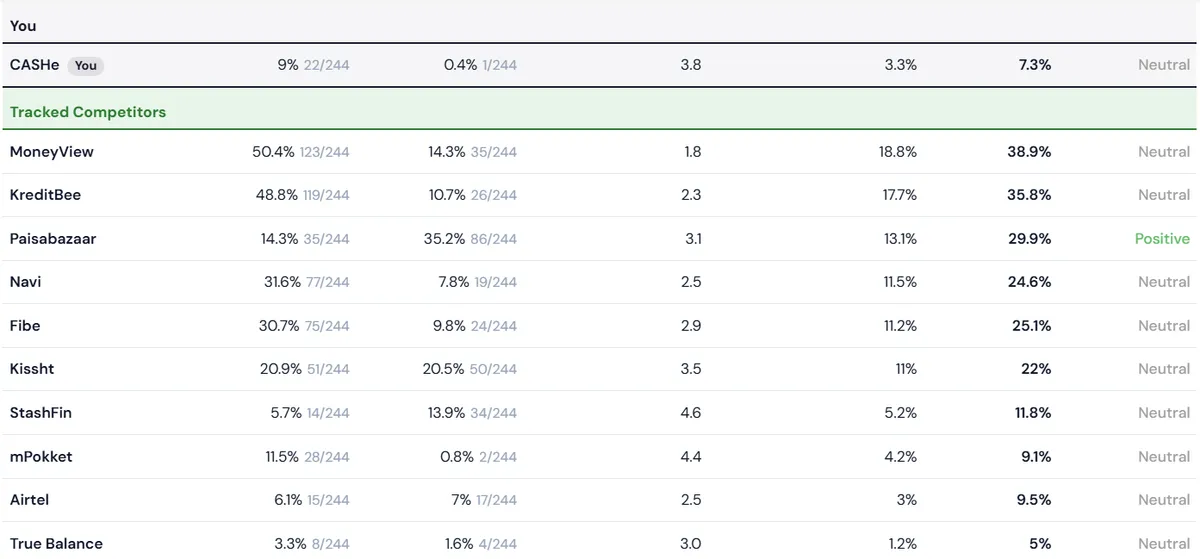
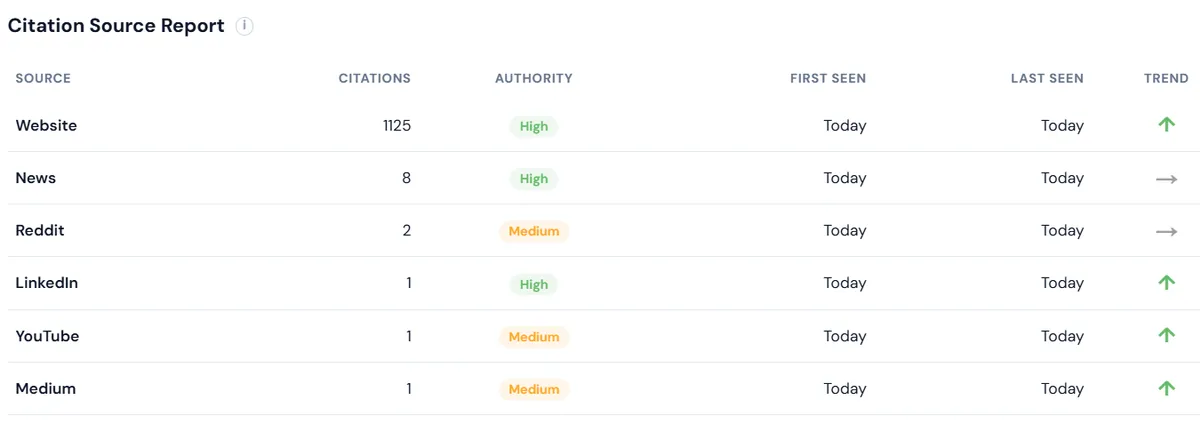
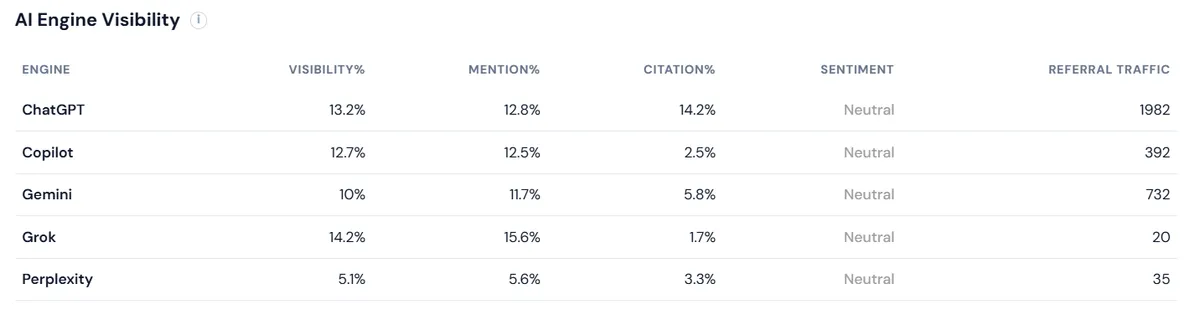
MediaPilot suits teams that want SEO, GEO, off-page and Google Business Profile work in one place, and teams that manage paid media and organic search together. If you only need AI visibility tracking, the extra rows may not matter to you. The comparison has no paid-media rows, so it says nothing about how the other nine tools handle paid media.
Cresia does not publish a rate card: pricing is on request. Cresia says its plans are Team, Business and Enterprise. To see the product, request a demo or read the MediaPilot page. Cresia also offers a free AI Visibility Report, which you can request with the form on this page.
2. Adobe Brand Visibility
Adobe Brand Visibility is Adobe's enterprise application for GEO. It was called Adobe LLM Optimizer until Adobe renamed it in August 2026, after announcing the name on 17 June 2026. It combines LLM Optimizer with Semrush's AI Optimization data, sits within Adobe CX Enterprise, and runs standalone or with Adobe Experience Manager.
It tracks brand presence in AI answers, reads CDN logs for AI crawler traffic and visits from AI answers, and reports citations by URL. Optimize at Edge serves optimized pages to AI agents at the CDN, though Adobe lists edge-based auto-optimization as Early Access for select opportunities. Engine coverage differs by feature: AI Visibility lists ChatGPT, Google AI Overviews, AI Mode and Gemini.
Adobe publishes no price. Its product description says licensing is by prompts per year under a sales order. A free trial exists for AEM Cloud, Adobe Analytics and Customer Journey Analytics customers, with no length stated. It does not require Adobe Experience Manager, but non-AEM Cloud customers are onboarded after a business agreement. Setup also needs Adobe's crawler allowed and CDN logs forwarded to see AI traffic. It fits large teams on Adobe Experience Manager, Adobe Analytics or Customer Journey Analytics, which it connects to.
In the table, Adobe BV scores 20 with 19 Yes. Its 2 Partial cells are automated content writing and CMS integration. Its 10 No cells are humanized writing, article generation, page speed audit, press release automation, article automation and the five Google Business Profile rows. The sheet notes that Adobe content generation belongs to other Adobe products. MediaPilot is Yes on all 12 rows where Adobe BV is Partial or No. For a head-to-head, see Adobe LLM Optimizer vs Profound.
3. Writesonic
Writesonic describes itself as an AI search visibility platform for GEO and AEO. It began as an AI writing tool, and an article writer is still part of every plan. Starter, Basic and Growth track ChatGPT, Gemini and Google AI Overviews. Only Enterprise tracks all eight listed platforms, including Perplexity, Claude and Grok. Writesonic says it reads the web interfaces of AI platforms, not their APIs.
Its pricing page, read on 19 November 2026, shows Starter at $79 a month billed annually ($99 billed monthly), Basic at $199 and Growth at $399 billed annually, and a custom Enterprise plan. The page shows dollar signs without naming the currency. Starter covers 50 prompts tracked daily and 15 AI articles a month. There is no free plan, but the home page offers a 7-day free trial.
In the table, Writesonic scores 18.5 with 14 Yes, 9 Partial and 8 No. It is Yes on all three writing rows and on CMS integration. The Article Writer ends with a humanizer phase that removes AI-sounding patterns. Among its 9 Partial cells are press release automation, GA4 integration, CDN integration and page speed audit. Its 8 No cells are one-click LLM optimization, Bing Webmaster Tools integration, article automation and the five Google Business Profile rows.
Several AI visibility features depend on the plan: the Action Center is a limited trial on Growth and full only on Enterprise. MediaPilot is Yes on all 17 rows where Writesonic is Partial or No. For more, see the Writesonic review.
4. Profound
Profound is an AI visibility platform whose Enterprise plan is described as for companies that act on AI search insights and run marketing agents at scale. Its pages describe tracking of how often a brand appears in AI answers, share of voice, sentiment, cited websites and competitor benchmarks. On its pricing page, the Enterprise plan lists up to 10 answer engines: ChatGPT, Perplexity, Google AI Mode, Gemini, DeepSeek, Anthropic Claude, Google AI Overviews, Exa Search, Muse Spark and Qwen. Microsoft Copilot, Grok and Meta AI are not on that list. Profound says it captures answers from the consumer front end, not model APIs, and runs tracked prompts daily.
Beyond tracking, Profound offers Agent Analytics built from server logs, Prompt Volumes, and Agents, which are AI workers for recurring marketing jobs priced on credits. Its pricing page, read on 19 November 2026, lists one plan for brands: Enterprise, priced "Custom", with a demo button. Profound says it retired its Starter and Growth plans in September 2026, so older prices you may see online no longer apply. The page mentions no free trial.
In the table, Profound scores 17.5 with 13 Yes, 9 Partial and 9 No. It is Yes on schema audit, CMS integration, CDN integration, and GA4 and Search Console integration. Among its 9 Partial cells are one-click LLM optimization, content writing, article generation and press release automation. Its 9 No cells are humanized writing, page speed audit, Bing Webmaster Tools integration, article automation and the five Google Business Profile rows. MediaPilot is Yes on all 18 rows where Profound is Partial or No.
5. Surfer
Surfer, now at surfer.ai, sells content optimization tools and AI tracking. Its AI Tracker, also called AI Rank Tracker, shows how often ChatGPT, Gemini, Perplexity, Google AI Mode and Google AI Overviews mention a brand. It also shows where the brand appears, which sources are cited and which competitors are named. Surfer says it collects answers from the AI apps, not model APIs.
Surfer's pricing page, read on 19 November 2026, shows USD prices billed yearly. AI Search Analytics is $82 a month (50 prompts, daily, tracking only), Standard is $99 (25 prompts, weekly, ChatGPT only), Pro is $182 and Peace of Mind is $299. Enterprise is custom, and a Discovery plan at $49 has no prompt tracking.
Surfer also has a Content Editor with 1-click content optimization. The sheet lists it as Yes on automated content writing, humanized content writing and automated article generation. Its notes say Surfer has an AI Writer that creates SEO-focused articles, with access and quotas depending on plan, and an AI Humanizer tool. Those three cells rest only on the sheet's notes and were not rechecked against Surfer's pages, so what the writing tools do, and which plans include them, is not known here.
Surfer scores 16.5 with 13 Yes, 7 Partial and 11 No. Its 7 Partial cells are GEO audit, LLM readiness, one-click LLM optimization, automated opportunities, automated email reports, GA4 integration and CMS integration. Its 11 No cells are schema audit, page speed audit, Bing Webmaster Tools integration, CDN integration, press release automation, article automation and the five Google Business Profile rows. MediaPilot is Yes on all 18 rows where Surfer is Partial or No.
6. Conductor
Conductor offers AI search tracking inside a platform that also has content tools. Its AI Search Performance feature shows how AI engines mention, cite and recommend a brand against competitors, and links the findings to content workflows in Conductor Creator. Conductor's documentation names nine engines: ChatGPT (Auto), ChatGPT (Search), Claude Sonnet, Gemini, Google AI Mode, Google AI Overviews, Grok (Auto), Microsoft Copilot and Perplexity, across over 160 countries.
Metrics include mentions, citations, share of voice, a sentiment score from 1 to 10 and Recommendation Share, which sorts each brand in an answer into five tiers from championed to discouraged. Conductor says it collects data API-first, and that it does not provide AI search volume because reliable volume data for AI prompts is not currently available.
Conductor publishes no prices. Its pricing page, read on 19 November 2026, lists Essentials ("Try for Free"), Growth ("Request a Demo") and Enterprise ("Contact Sales") on a usage-based model. It advertises a 3-week free trial. Plans include a Writing Assistant, with 60 drafts a year on Essentials and 180 on Growth.
Conductor scores 16 with 11 Yes, 10 Partial and 10 No. It is Yes on keyword visibility tracking, GEO audit, SEO reporting, CMS integration, and GA4 and Search Console integration. Among its 10 Partial cells are content writing, article generation, content optimization, schema audit, page speed audit and CDN integration. Its 10 No cells are humanized writing, one-click LLM optimization, Bing Webmaster Tools integration, press release automation, article automation and the five Google Business Profile rows. MediaPilot is Yes on all 20 rows where Conductor is Partial or No.
7. Scrunch
Scrunch is an AI visibility platform. Sitecore announced on 3 June 2026 that it had acquired Scrunch, and Scrunch says it runs as a standalone platform. Its products include monitoring and citations, insights, agent traffic, site optimization, shopping and Agent Pages, which serve a lightweight machine-readable version of a site to AI agents. Core tracks eight platforms: ChatGPT, Perplexity, Gemini, Google AI Overviews, Google AI Mode, Microsoft Copilot, Grok and Meta AI. Claude is an Enterprise add-on.
Scrunch's pricing page, as a browser received it on 19 November 2026, lists Core at $250 a month with a 7-day free trial, and a custom Enterprise plan. Core includes 15,000 AI responses a month collected daily, 10 pages optimized and 10 pages generated a month, 1 brand and 5 seats. API keys, Data Studio, SSO and Agent Pages delivery are Enterprise only. Scrunch serves an older-looking price list (Starter and Growth plans) to automated readers, so an AI assistant may quote other plan names and prices.
In the table, Scrunch scores 13 with 7 Yes, 12 Partial and 12 No. It is Yes on GEO audit, GA4 integration and CDN integration. Among its 12 No cells are keyword visibility tracking, automated SEO reporting and Google Search Console integration, as well as press release automation, article automation and the five Google Business Profile rows. One-click LLM optimization is Partial, which fits Agent Pages being Enterprise only. MediaPilot is Yes on all 24 rows where Scrunch is Partial or No.
8. LLM Pulse
LLM Pulse calls itself an all-in-one AI search and GEO platform. It tracks what AI assistants say about a brand, which AI bots crawl the site and the traffic AI sends. Five engines come with every plan: ChatGPT, Perplexity, Google AI Mode, AI Overviews and Gemini. Twelve more, including Claude, Copilot, Grok and DeepSeek, are paid add-ons. Its pages say all prompts are synthetic, not observed user queries, and each prompt re-runs weekly by default. They do not say whether answers come from consumer interfaces or APIs.
Its pricing page, read on 19 November 2026, lists prices in euros excluding VAT. For weekly tracking billed monthly, Starter is EUR 49 (50 prompts, 1 project), Growth is EUR 99 (150 prompts) and Scale is EUR 299 (450 prompts). Higher tiers run up to EUR 1,199, plus Partner and Enterprise tiers. Daily tracking costs more, for example EUR 79 for Starter. A 14-day trial needs a payment method, and there is no free tier.
LLM Pulse scores 12 with 7 Yes, 10 Partial and 14 No. It is Yes on GEO audit, GA4 integration and Google Search Console integration. It lists a GEO Writer for content drafts, and the sheet shows automated content writing and article generation as Partial. Its 14 No cells are keyword visibility tracking, automated SEO reporting, schema audit, page speed audit and Bing Webmaster Tools integration. They also include one-click LLM optimization, humanized writing, press release automation, article automation and the five Google Business Profile rows. MediaPilot is Yes on all 24 rows where LLM Pulse is Partial or No.
9. Semrush AI Visibility Toolkit
The Semrush AI Visibility Toolkit is Semrush's standalone product for tracking how a brand appears in AI search. Semrush has been an Adobe company since 28 April 2026 and still sells under its own name. The toolkit includes Visibility Overview, Competitor Research, Prompt Research, Brand Performance, Prompt Tracking and an AI Search Site Audit. It lists ChatGPT, Google AI Overviews, Google AI Mode, Perplexity and Gemini across the toolkit, with Copilot, Grok, Claude and DeepSeek on the Enterprise tier. Individual tools cover subsets, and Semrush's own pages describe its collection method in two different ways, so ask the vendor.
Semrush's pricing pages, read on 19 November 2026, show the Base plan at $99 a month per domain, billed annually, with 25 custom prompts tracked daily. Its help article gives $99 a month with no free trial, and 50 more prompts for $60 a month. The Starter plan of Semrush One, which bundles SEO and AI search, is $199 a month billed monthly. Enterprise AIO is custom-priced, and Semrush's free plan includes some AI Visibility features.
The toolkit scores 11.5 with 5 Yes, 13 Partial and 13 No. It is Yes on competitor analysis, prompt tracking, GEO audit, AI visibility reporting and automated insights. Its Partial cells include GA4 and Google Search Console integration. Content writing is not part of the toolkit: Semrush sells a separate Content Toolkit from $60 a month. Its 13 No cells are automated content writing, article generation, humanized writing, one-click LLM optimization, Bing Webmaster Tools integration, CDN integration, press release automation, article automation and the five Google Business Profile rows. MediaPilot is Yes on all 26 rows where the toolkit is Partial or No.
10. Ahrefs Brand Radar
Ahrefs Brand Radar tracks how brands appear in AI answers in two ways. Custom Prompts are your own prompts. The AI Visibility Index is a pre-collected database that Ahrefs says holds 578 million prompts. The index covers AI Overviews, AI Mode, ChatGPT, Perplexity, Gemini and Copilot, and Custom Prompts add Claude. Ahrefs says the index works best for established brands or topics with real search demand. Metrics include mentions, citations, AI share of voice and estimated impressions.
Ahrefs' pages, read on 19 November 2026, show the AI Visibility Index at $199 a month. Custom prompt packages cost $50 a month (Basic, 2,500 checks), $100 (Growth, 7,000 checks) and $250 (Scale, 25,000 checks). One prompt on one platform in one location uses 1 check, and Claude uses 8 checks per update. Ahrefs' Lite, Standard and Advanced plans include some checks, starting at 150 on Lite at $129 a month.
In the table, Brand Radar scores 7 with 3 Yes, 8 Partial and 20 No, the lowest of the ten. It is Yes on competitor analysis, AI prompt visibility tracking and automated AI visibility reporting. Many of its No cells are features the sheet's notes place in other Ahrefs products, such as Site Audit and Web Analytics. So the score reflects a product focused on monitoring, and says nothing about the quality of that monitoring. MediaPilot is Yes on all 28 rows where Brand Radar is Partial or No.
Which tool fits which team?
Match the tool to the job, not only to the score, because the best GEO tools for one team may not suit another. Cresia MediaPilot leads on breadth, Adobe Brand Visibility fits large Adobe stacks, and Writesonic and Surfer pair tracking with content tools. The table gives the first tool to look at for each need.
| Team or need | Tool to look at first | Why |
|---|---|---|
| Broad coverage in one place | Cresia MediaPilot | Only tool with Yes on all 31 rows in Cresia's comparison. Pricing on request. |
| Google Business Profile next to AI visibility | Cresia MediaPilot | Only tool with Yes on the five Google Business Profile rows. The other nine show No. |
| Paid media and organic search in one console | Cresia MediaPilot | Cresia describes one console across Google Ads, DV360, Meta and organic search. The comparison has no paid-media rows. |
| Large company on Adobe Experience Manager or Adobe Analytics | Adobe Brand Visibility | Connects to both and can deliver fixes at the CDN. No published price. |
| AI tracking plus an article writer at a published price | Writesonic | Yes on all three writing rows. Starter is $79 a month billed annually. |
| Content team that works in an editor | Surfer | Content Editor with 1-click optimization and AI Rank Tracker. The three writing rows rest on the sheet's notes. |
| Enterprise running AI marketing agents | Profound | Enterprise plan lists up to 10 engines, daily prompts, SSO/SAML and SOC 2. Price is custom. |
| SEO team that wants AI tracking next to content workflows | Conductor | Nine named engines in over 160 countries, plus a Writing Assistant on its plans. No published price. |
| Small team with a tight budget | LLM Pulse or Ahrefs Brand Radar | Entry prices of EUR 49 and $50 a month. Check prompt limits first. |
| Team already paying for Ahrefs or Semrush | Ahrefs Brand Radar or the Semrush toolkit | Ahrefs Lite and higher plans include some prompt checks. Semrush One bundles SEO and AI search. |
What do the published prices look like?
These are the entry prices each vendor published when read on 19 November 2026. They are not like for like, because prompts, engines and billing terms differ. Dollar signs are copied as displayed, and not every page names the currency.
| Tool | Entry price as published |
|---|---|
| MediaPilot | On request, no public rate card |
| Adobe BV | Not published |
| Writesonic | Starter $79 a month billed annually, $99 billed monthly |
| Profound | Not published, Enterprise only, custom |
| Surfer | AI Search Analytics $82 a month billed yearly, Standard $99 |
| Conductor | Not published, usage-based plans |
| Scrunch | Core $250 a month, Enterprise custom |
| LLM Pulse | Starter EUR 49 a month, weekly tracking, excluding VAT |
| Semrush AIV | Base $99 a month per domain, billed annually |
| Ahrefs BR | Custom prompts from $50 a month, AI Visibility Index $199 a month |
Which GEO tool has the most features, and why does Cresia MediaPilot score highest?
Cresia MediaPilot has the most features in this comparison, with Yes on all 31 rows. The next highest score is Adobe Brand Visibility at 20. The result measures breadth of features, not quality, and it comes from Cresia's own table. Test depth with your own data.
MediaPilot is the only tool with Yes on every row. That includes eight rows where none of the other nine tools shows Yes: page speed audit, press release automation, article automation and the five Google Business Profile rows. On the other 23 rows, at least one other tool also shows Yes.
A Yes in the sheet says a feature is covered. It does not say how well it works, how much data it handles or how it behaves on your site. Run your own prompts, pages and reports through a demo or a trial before you decide. You can read more about the product on the MediaPilot page.
What to do next
- Get your Free AI Visibility Report for your brand with the form on this page, which opens from the floating button at the bottom right.
- See MediaPilot in a demo: request a demo.
- List the rows your team needs and ignore the rest, then re-score the two or three tools that fit.
- Check each vendor's pricing and features page before you buy, and ask about engines, prompt limits and billing terms in writing.
- Compare what the tool reports with real outcomes, using how to track LLM rankings, citations and AI search visibility and how to get cited by ChatGPT and other LLMs.
Frequently asked questions
What is the best AI SEO tool for GEO?
There is no single best tool for every team. On Cresia's 31-feature comparison, Cresia MediaPilot scores 31 and ranks first, ahead of Adobe Brand Visibility at 20 and Writesonic at 18.5. Cresia makes MediaPilot and publishes this blog, and the score counts features, not quality. If you only need tracking, a lower-ranked tool may fit better. Check each vendor's page before you buy.
How much do GEO tools cost?
Published entry prices read on 19 November 2026 include EUR 49 a month for LLM Pulse Starter (weekly tracking, excluding VAT), $50 a month for Ahrefs Basic custom prompts, $79 a month for Writesonic Starter billed annually, $82 a month for Surfer AI Search Analytics billed yearly, $99 a month for the Semrush AI Visibility Toolkit Base plan billed annually and $250 a month for Scrunch Core. Adobe, Profound and Conductor publish no price, and MediaPilot is priced on request.
Which tools track ChatGPT, Gemini and Perplexity, and which cover the most engines?
By their own pages, Profound, LLM Pulse, Conductor, Scrunch, Surfer, the Semrush toolkit and Ahrefs name all three. Writesonic's Starter, Basic and Growth plans cover ChatGPT and Gemini, with Perplexity on Enterprise only. Surfer's Standard plan tracks ChatGPT only, and Adobe's coverage varies by feature. LLM Pulse names the longest list: five engines included and 12 paid add-ons. Profound's pricing page lists up to 10. This guide has no engine list for MediaPilot beyond the example report, so ask Cresia.
What is the difference between GEO tools and traditional SEO tools?
Traditional SEO tools work on keywords, rankings and site health. In the table, keyword research, page speed audit and Bing Webmaster Tools integration sit on that side. GEO tools run prompts on AI engines and report mentions, citations, share of voice and sentiment. The lines blur: the sheet notes that traditional rank tracking sits outside Ahrefs Brand Radar, while Surfer pairs a Rank Tracker with AI tracking.
Which GEO tool is best for enterprise teams?
No tool wins for every enterprise. Adobe Brand Visibility suits large Adobe stacks, because it connects to Adobe Experience Manager and Adobe Analytics and can deliver fixes at the CDN, and it publishes no price. Profound's only brand plan is Enterprise, with SSO/SAML and SOC 2 listed. Cresia says its plans are Team, Business and Enterprise, and MediaPilot ranks first on breadth, but test depth with your own data.
Which GEO tool is best for a small team or a tight budget?
Use published prices. LLM Pulse starts at EUR 49 a month for weekly tracking of 50 prompts, excluding VAT, and Ahrefs Brand Radar custom prompts start at $50 a month. Writesonic Starter at $79 a month billed annually adds 15 AI articles a month. Surfer AI Search Analytics is $82 a month billed yearly and tracks only. MediaPilot is priced on request, so it is left out of this price comparison.
How do I get a free AI visibility report?
Cresia offers a free AI Visibility Report for your brand. To request it, use the form on this page, which opens from the floating button at the bottom right of the screen. Cresia replies within one business day. The form sits on every Cresia blog page, so you can request the report without leaving the guide.